

Instruments > Physics
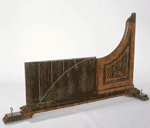
Apparatus to demonstrate the parabolic trajectory of projectiles
Maker: unknown
Late 18th C.
Wood, brass
1980x570x1250 mm
IMSS, Current inventory: 968
The apparatus was probably first described by
Willem Jacob 's Gravesande in Physices
elementa mathematica, experimentis confirmata (3rd ed., Leiden, 1742). It
demonstrates experimentally that gravitational acceleration causes a body
launched horizontally to describes a parabolic trajectory.
A wooden base, fitted with leveling screws,
holds a stand with a quarter-circle track and vertical panel on which a series
of four brass rings are fixed at equal distances along a parabola. A ball
falling down the track experiences a constant acceleration. When no longer
supported by the track, the ball's horizontal projection is combined with the
natural motion of uniformly accelerated fall; the ball's path thus becomes
parabolic, as evidenced by the fact that it goes through the entire series of
rings. The experiment confirms Galileo's discovery of the parabolic trajectory
of bodies as the result of the combination of horizontal projection and free
fall, defined by the Pisan scientist in c. 1609 and first published in the
Giornata Quarta [Fourth Day] of the Discorsi
and dimostrazioni matematiche intorno a due Nuove Scienze [Discourses
and Demonstrations on Two New
Sciences] (Leiden,
1638). Provenance: Lorraine collections.